
  Reverse Monte Carlo (RMC) is a simulation method, based on a variation of the Metropolis algorithm, which allows one to solve an inverse problem by adjusting the parameters of the model till the good consistency with experimental data is obtained. In our laboratory, we use computationally more efficient realization of the RMC method, based on the evolutionary algorithm, to perform interpretation of EXAFS spectra by reconstructing the 3D atomic structure of a solid. The use of the RMC method allows us to overcome problems related to accurate accounting for disorder effects beyond the first coordination shell of an absorbing atom, in the region, where a contribution of the multiple-scattering (MS) effects, related to many-atom correlation functions, is not negligible. EvAX - simulation-based analysis of EXAFS data for crystalline and nanocrystalline materials. More information can be obtained from
EXAFS study of hydrogen intercalation into ReO3 using the evolutionary algorithm, J. Phys.: Condens. Matter 26 (2014) 055401 (15pp). J. Timoshenko, A. Kuzmin, J. Purans, Reverse Monte Carlo modelling of thermal disorder in crystalline materials from EXAFS spectra, Comp. Phys. Commun. 183 (2012) 1237-1245. 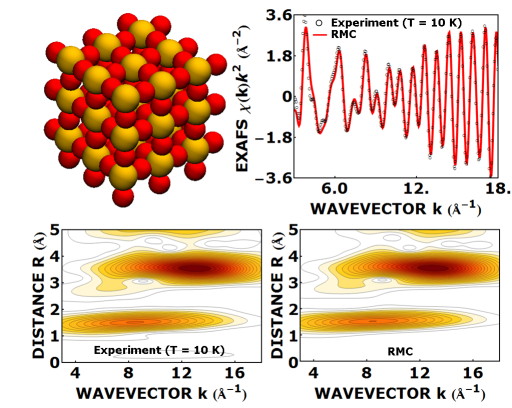 RMC analysis of the Re L3-edge EXAFS in ReO3
|

|
 Institute of Solid State Physics, University of Latvia |
 
 ENG LV |

|
  
|